Religious Education
Educating for life in all its fullness, committed to excellence and enjoyment through learning, within an enabling environment that nurtures the potential and talents of all; empowering our children with wisdom, knowledge and skills; grounded in the Christian belief that everyone is created in the image and love of God.
Our aims in RE are for pupils to:
- Gain knowledge and understanding of Christianity and encourage dignity, respect and value for all through studies of other world faiths;
- Have an understanding of what it means to be committed to a religious tradition and to appreciate cultural differences;
- Develop an awareness of spiritual and moral issues in life experiences;
- Have an awareness of the fundamental questions of life, raised by human experiences, and how religious teaching relates to them;
- Provide understanding of how religion and beliefs affect our lives;
- Challenge, discuss and question religion, and their understanding of faith and their faith;
- Provide a curriculum that allows exploration of theological concepts;
- Expose children to religious literature;
Religious Education curriculum
As a Church of England academy, we recognise the core place that RE occupies as part of a broad and balanced curriculum. We also understand the contribution of effective RE to our journey towards realising our school’s distinctively Christian vision.
We recognise the variety of religious and non-religious backgrounds that make up our school community and we respect this variety of backgrounds in the spirit of Christian welcome. We are glad to have good relationships with faith practitioners from a range of world faiths and we value their contribution to our provision of effective RE.
We actively seek to prepare our pupils for life in modern Britain. As such, we promote key British values, including respect for and tolerance of different faiths and beliefs. We challenge racism and all forms of prejudice and we see RE as one curriculum area in which our pupils can encounter and critically reflect on a range of worldviews.
We aim to provide a progressive RE curriculum; one that develops in depth of knowledge, skills and thinking as a child grows both academically and spiritually. Therefore, the long term sequence takes into account cognitive load and learning theories to ensure that children revisit areas studied repeatedly throughout their learning journey at the academy; Techniques such as interleaving, spacing, recapping core concepts, dual coding and knowledge organisers are embedded within everyday practice. Christianity, Judaism, Islam and Hinduism are the principal studies taught progressively through each key stage. Furthermore, children will also encounter non-religious worldviews, such as Humanism, as part of their RE curriculum.
Teaching and learning
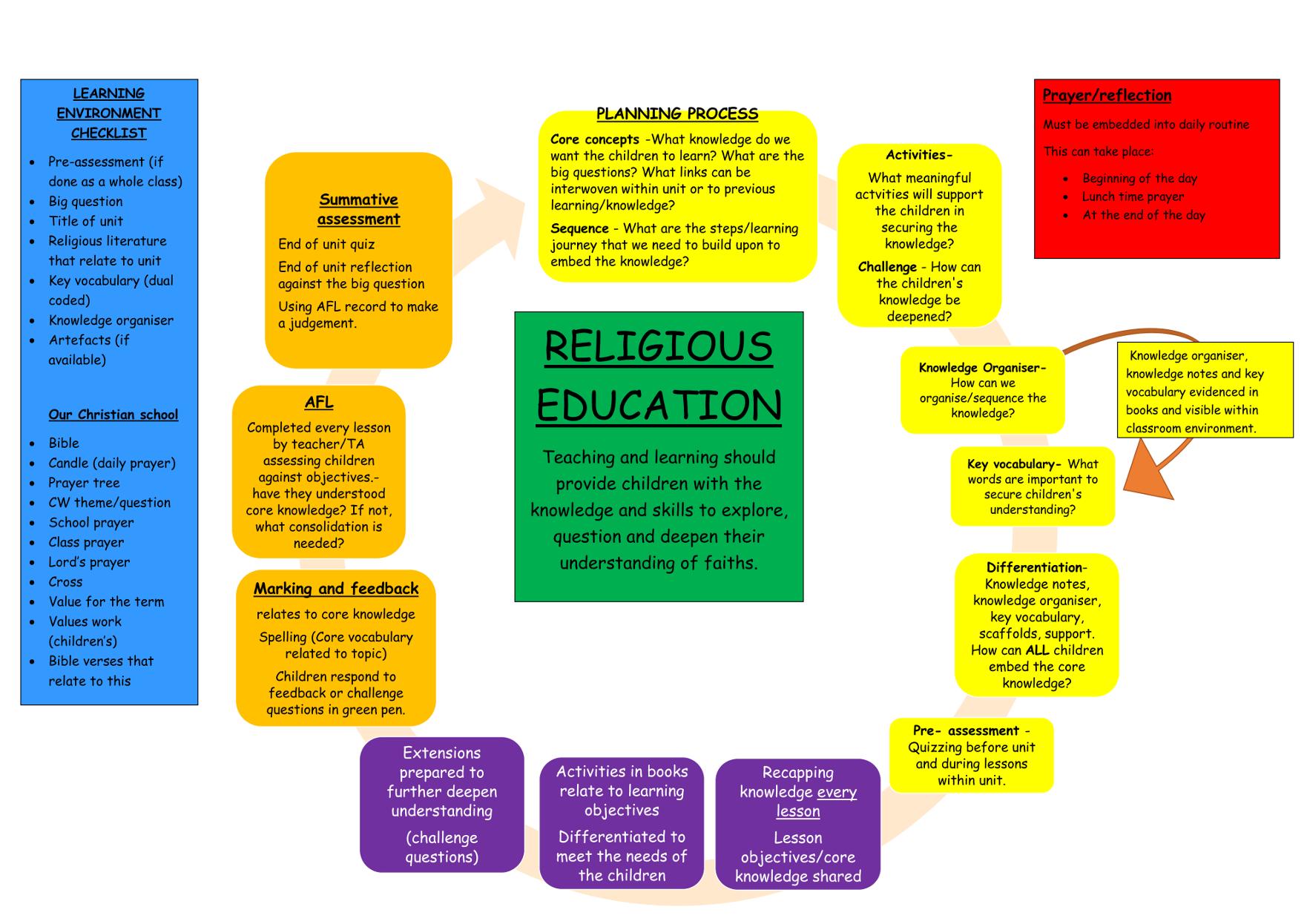
We carry out curriculum planning for RE in three phases (long-term, medium-term and short-term). The long-term plan maps the sequence of learning in RE; the medium-term plan gives details of each unit of study delivered to each Key Stage. The class teacher writes the plans for each lesson using a process planner (Appendix one) that provides clear expectations and non-negotiables concerning planning, marking/feedback, assessment and the learning environment. These are discussed when required with the RE Subject Leader/RE curriculum team and form part of the annual monitoring process for RE teaching and learning.
The Spiritual and Moral development of a child is difficult to assess but the written/theoretical side of RE is more straightforward. The class teacher will use assessment strategies (such as low-stake quizzes and other retrieval practice techniques) before and throughout the topic to ascertain the children’s learning and modify future sessions to ensure progress is made by all. In addition, at the end of a topic, quizzes, assessment for learning records and unit reflections are used to make a summative judgement against the end of year expectations in the three strands believing (theology), living (human and social science) and thinking (philosophy).
Through teaching and learning, we want our children to have the wisdom, knowledge and skills to live their lives in fullness. It is our hope that our children will become leaders and advocates in school, and in their community; with the deep belief that each person is created in the image of God.
Supporting All Learners
We live in a multi-cultural, multi-racial society and encourage the respect and understanding of other religions and cultures within the community in which we live, to promote dignity and the value of all. We intend to follow Jesus’ example to love and serve one another so that all may be included, regardless of race & culture. We believe that all children irrespective of race, ability and gender should have equal access to the RE curriculum. Children with special educational needs will work on the same content but there will be appropriate differentiation where required. Whole school policy with regards to SEND and differentiation applies to RE.
Inspection
The effectiveness of RE is inspected as part of the Section 48 SIAMS (Statutory Inspection of Anglican and Methodist Schools) inspection. Lisle Marsden Church of England Academy is a Voluntary Aided school. As such, progress and attainment in RE is inspected as a distinct element of the Section 48 SIAMS inspection.
Withdrawal from RE
The recent Education Acts establish the parent’s right to withdraw their children from Religious Education if they wish. However, by the fact that the parents have opted to send their children to a church school it is hoped that this will not be necessary.
Any queries regarding withdrawal from RE should be directed to the RE Subject Leader in the first instance, and thereafter to the head teacher. Full details of withdrawal can be found within our RE policy.


|
Appendix 1 - Model of R.E planning process updated April 2021 | [docx 139KB] |

|
|
|
Islam core concept learning journey through syllabus | [docx 110KB] |
|
|
|
Year 1 Summer 1 Islam- Knowledge Organiser | [docx 286KB] |
|

|
End of unit reflection Y3 Judaism | [pub 111KB] |
|
|
|
Y3 Judaism - Quiz | [docx 360KB] |
|
|
|
Y6 RE People of God Knowledge Organiser | [docx 391KB] |
|
|
|
Y6 People of God planning 20-21 | [docx 414KB] |
|
|
|
End of unit reflection Y6 People of God | [pub 194KB] |
|

|
RE Policy 2026 | [pdf 194KB] |
|