Maths
Lisle Marsden Academy recognises the importance of Maths for all pupils, regardless of ability, as a subject that helps to prepare them for the rigours and demands of adult life. All children throughout the academy will be given equal opportunity to experience every aspect of the Maths curriculum using modifications and differentiation, as necessary.
The intent of our maths teaching at Lisle Marsden Academy are aligned with the aims of the National Curriculum: fluency, reasoning and problem solving, both in the mathematics lesson and across the curriculum.
All learners should be numerate and able to use and apply mathematical thinking and skills in everyday life, with confidence.
We encourage learners actively to seek ways of connecting their learning to their present and future lives, the communities around them and to their own capabilities as learners.
A mastery approach to the teaching of mathematics has been adopted using the Maths - No Problem scheme; we have high expectations of all our pupils. We endeavour to make the mathematics curriculum accessible to all pupils; moving them through the programme of study at broadly the same pace. All children need a deep understanding of the mathematics they are learning in order that future learning is built upon firm foundations. We use the ‘5 Big Ideas’ to underpin our teaching for mastery maths: Coherence, Representation & Structure, Variation, Fluency and Mathematical Thinking.
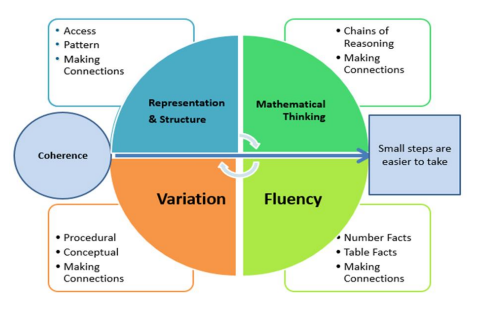
Through our mastery maths approach, we intend:
· To deliver the National Curriculum using the Maths No Problem Scheme as a Primary resource with the 5 Big ideas of Mastery incorporated.
· To ensure that all children are offered the chance to improve their maths skills and reach their full potential.
· To enable pupils to learn in different types of contexts and create very deliberate, carefully structured multi-sensory learning experiences to cater for each child’s learning styles.
· To promote Mathematics to be an enjoyable subject where learners continue to learn it independently and collaboratively.
· To understand and articulate the nature of mathematical thinking and processes.
· To develop reasoning and a deep understanding using a variety of contexts and representations.