CURRICULUM STATEMENTS OF INTENT, IMPLEMENTATION AND IMPACT
Intent
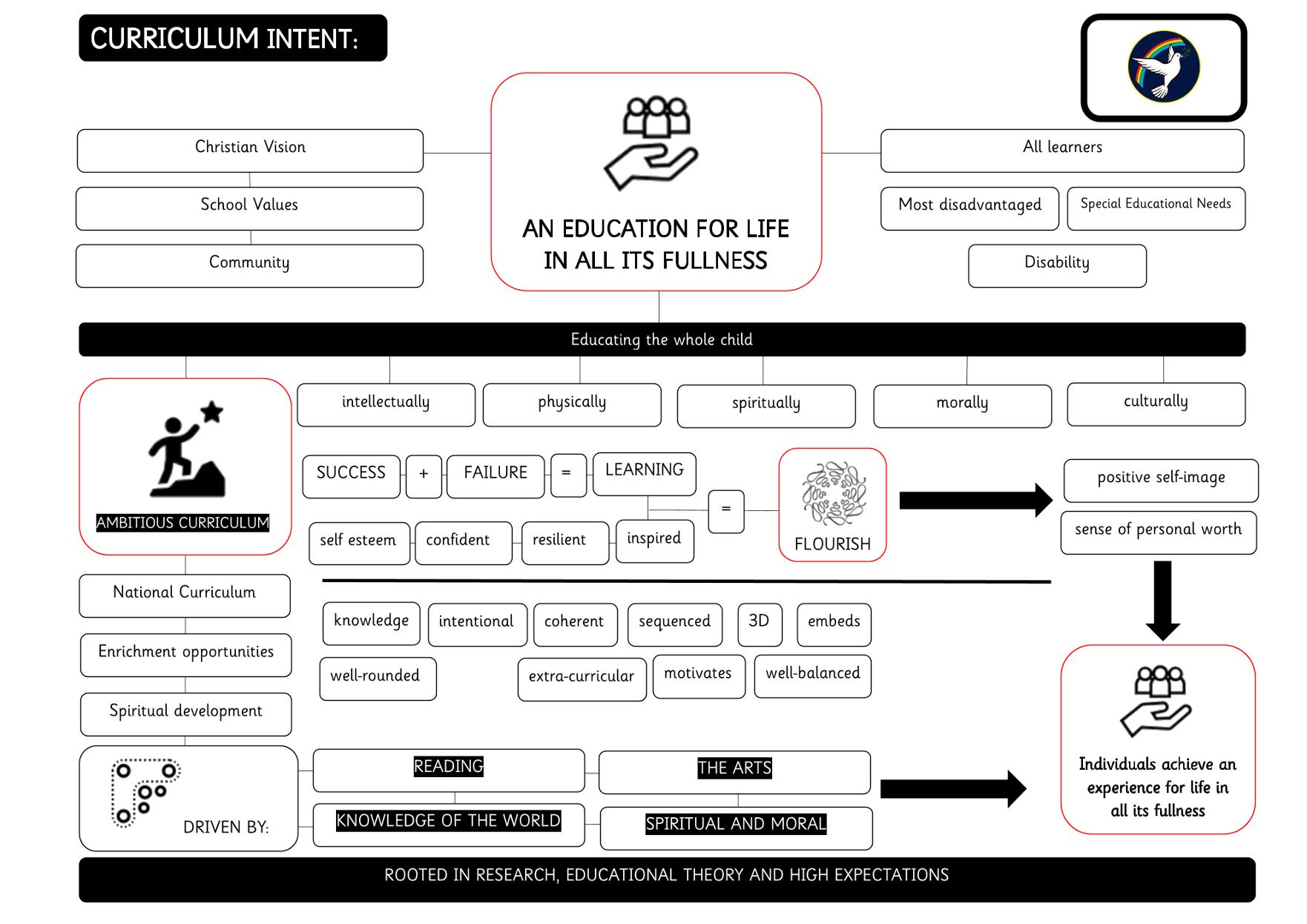
Our curriculum intent is the product of our Christian Vision and Values and the community in which we serve. We are intent on providing an education for life in all its fullness for all our learners, including the most disadvantaged and those with special educational needs and/or disabilities. It is about ‘educating the whole person’ which means to provide an ambitious well-rounded curriculum that enables the development of the whole child’s physical and intellectual development united with spiritual, moral, social and cultural development.
The school’s intent is to give everyone the opportunity to develop a positive self-image and sense of personal worth. Both success and failure are seen as paths to learning. Thus enabling children and the communities connected to Lisle Marsden CE Primary Academy to flourish.
Our Curriculum covers the statutory aspects of the National Curriculum whilst incorporating many opportunities for enrichment and spiritual development. The knowledge gained from the National Curriculum, coinciding with our enrichment opportunities and spiritual development, contribute to providing an education for life in all its fullness. Through a combination of learning techniques, we aim to ensure pupils enjoy learning and feel prepared for future learning. We also intend to offer our pupils new and exciting experiences through extra-curricular activities that are designed to build resilience, confidence and self-esteem.
Our key curriculum drivers of Reading, Knowledge of the World, The Arts and Spiritual and Moral are intentionally wide-ranging and inclusive as we feel that these drivers are equally important in achieving our curriculum intent for the whole child and support our curriculum in accelerating in a well-measured, well-rounded and strategic manner.
To provide an education for life in all its fullness, our coherently planned curriculum is well-balanced, carefully sequenced towards cumulatively sufficient knowledge and skills for future learning. The children receive a connected experience within our curriculum of life and the wider world.
Children revisit and build on prior skills and knowledge, and learn new skills and knowledge, in order to prepare them for the next steps of their learning. Our 3D curriculum ensures that there are links within a subject, and across subjects, within a year group, and across year groups. Our curriculum is carefully and intentionally mapped out to ensure a well-rounded and fluent experience of learning which embeds knowledge, engages, motivates and inspires.
To enhance the fluency of children’s learning in our curriculum, our intent is rooted in research and educational theory. Retrieval practice, dual coding and spaced-learning are some of the key elements of our practice to ensure that children build schemas to expand long term memory and rely less on their working memory. The approach intends to build knowledge, skills and confidence that can be applied across different life-contexts and situations to support individuals to achieve and experience life in all its fullness.
Below is a graphic organiser summarising the key messages of our curriculum intent.
Implementation:Teaching and Learning
The implementation of teaching and learning is expanded further in the Teaching, Learning and Formative Assessment Policy (September 2021)
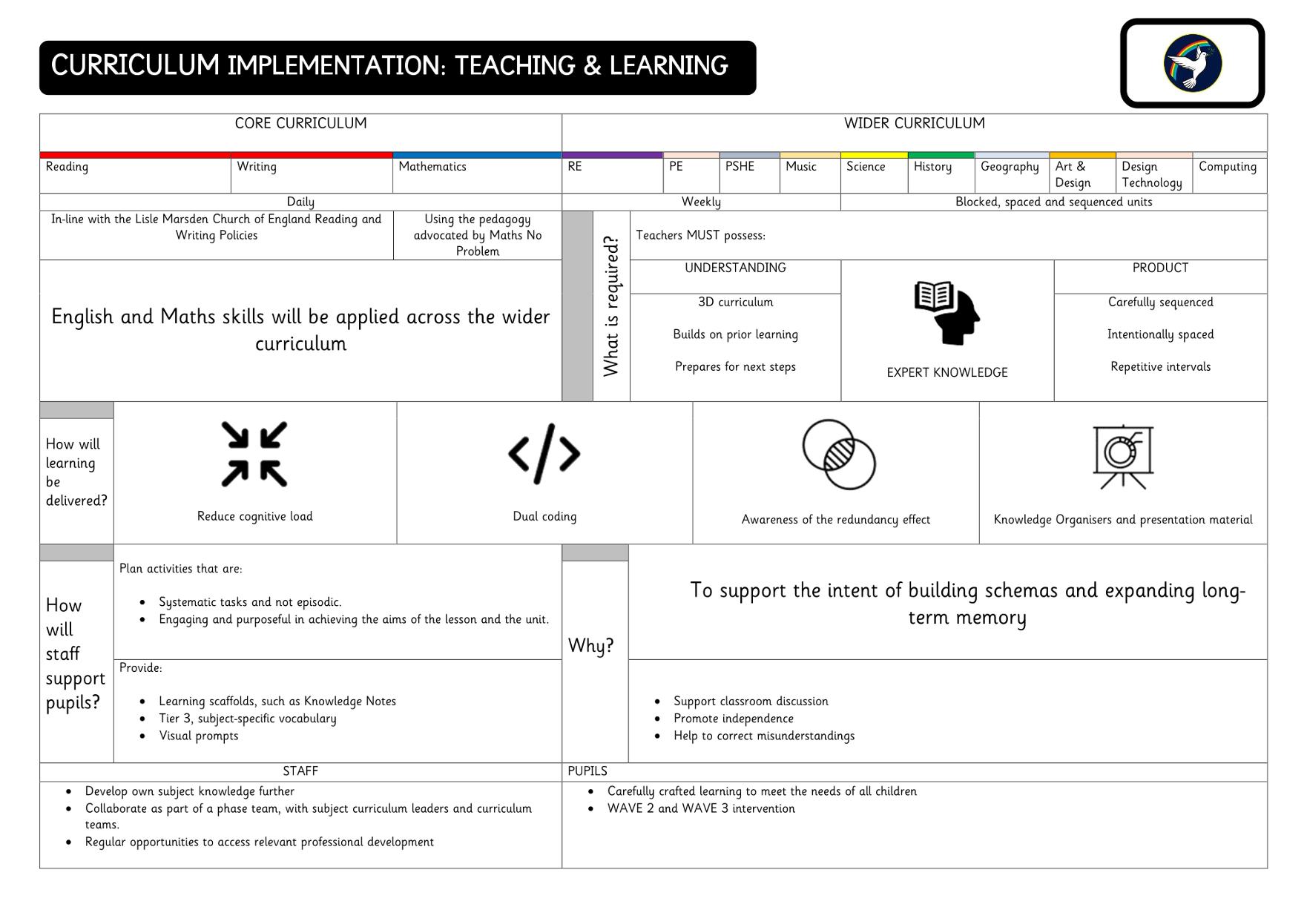
Teaching of the core subjects of reading, writing and mathematics will have a greater emphasis and will be taught discretely. The academy has a rigorous approach to the teaching of reading and writing to develop the children’s confidence and enjoyment in reading and writing. Reading and writing will be taught daily in line with the academy reading and writing policies. Mathematics will be taught daily using the pedagogy advocated by ‘Maths No Problem’ - a DFE accredited textbook approach to mathematics. There will be further opportunities to apply mathematics and English skills across the wider curriculum. There will be a weekly lesson of RE. PE will be taught twice weekly and there will be an opportunity for children to attend extra-curricular PE clubs.
Other curriculum areas will be blocked. Before delivering a subject-specific, blocked unit of work, teams of teachers will ensure that they have an expert knowledge of the unit content and know where the unit fits within our 3D curriculum. They will know which subjects the unit will cross-link to and know what knowledge was taught previously. They will know how they will build on previous knowledge in preparation for our children’s next stage of learning.
Learning is carefully sequenced so that children can revisit previous learning through intentionally spaced, repetitive intervals in order for knowledge to transfer to long term memory. New learning will be delivered in a sequence that reduces cognitive load and expands the capacity of working memory. To reduce cognitive overload, strategies such as dual coding and the redundancy effect are carefully considered when delivering new content through our clear classroom presentation materials and our knowledge organisers.
Classroom activities are carefully considered and support the intent to build schemas and expand long-term memory. Systematic tasks in the classroom are engaging and purposeful in achieving the aims of the lesson and the unit.
To support all children to apply new and prior knowledge independently, learning scaffolds and supports will be put in place to ensure that every child can access the curriculum. Scaffolds will consist of tier 3, subject-specific vocabulary and visual prompts that will support appropriate discussion and not only support all children access learning independently but will be used as a tool in helping to correct misunderstandings.
Across all the curriculum areas, the learning will be carefully crafted to meet the needs of all the children. In addition, children will receive additional interventions to close the learning gap.
Staff have, and will continue to have opportunities to develop their subject knowledge by working as part of a phase team and with subject leaders and curriculum teams. Furthermore, they will have regular opportunities to access relevant professional development.
Below is a graphic organiser summarising the key messages of our curriculum implementation.
Implementation:Assessment
The implementation of assessment is expanded further in the Teaching, Learning and Formative Assessment Policy (September 2021)
Teachers will regularly assess learning outcomes in the core subjects of mathematics, writing and reading and the wider curriculum using formative and summative assessment to establish what has been learned and use this information to inform teaching and further interventions.
Formative assessment
Teachers will assess the quality and depth of learning. They check learners’ understanding systematically, identify misconceptions accurately and provide clear, direct feedback. They use a range of formative techniques, for example: by observation and questioning to identify depth of understanding; evaluating pupil outcomes during the sequence of learning and low stakes quizzing. This will inform a child on how well they have done, their next steps in learning and identify the successes to motivate the child further.
Summative assessment
In addition, summative assessments of learning will be carried out through termly testing in the core subjects of mathematics, reading, writing, and grammar, punctuation and spelling (GAPS) which will identify the learning which is embedded, inform next steps and further areas for consolidation and intervention.
Impact
All children will have had an education for life in all its fullness during their time at Lisle Marsden CE Primary Academy. Children will leave as well-rounded individuals with the tools to succeed in future learning, achieving the curriculum intentions.
Children will articulate and present their knowledge and understanding of the world through high quality discussion and presentation of learning. Children will understand their community, value and make the most of their school and local area to help them grow into reliable, independent and positive citizens. They will have a firm grasp of the challenges and opportunities people face both domestically and internationally.
They will have a strong appreciation for the Arts and will have had extensive opportunities to develop their musical skills and passion through regular professional music tuition in key stage 2 and collaborative local projects. Furthermore, there will be cross curricular opportunities to extend the children’s appreciation of the arts.
Children will leave Lisle Marsden as fluent readers with strong comprehension skills and have had an opportunity to read a wide range of reading material.
The children will be successful academically and achieving to high standard at the end of key stage 2.
Through the many opportunities at Lisle, children will be courageous advocates of change at a local level, national level and globally. They will value the importance of understanding and supporting others in the local community and beyond with regular opportunities to play an important part in charity work.
The explicit teaching and continuous opportunities to reflect upon the academy Christian values, throughout their time at Lisle Marsden, will instill character virtues to support the children to embrace life, future learning and experience life in all its fullness.
Below is a graphic organiser summarising the key messages of the impact of our curriculum.
